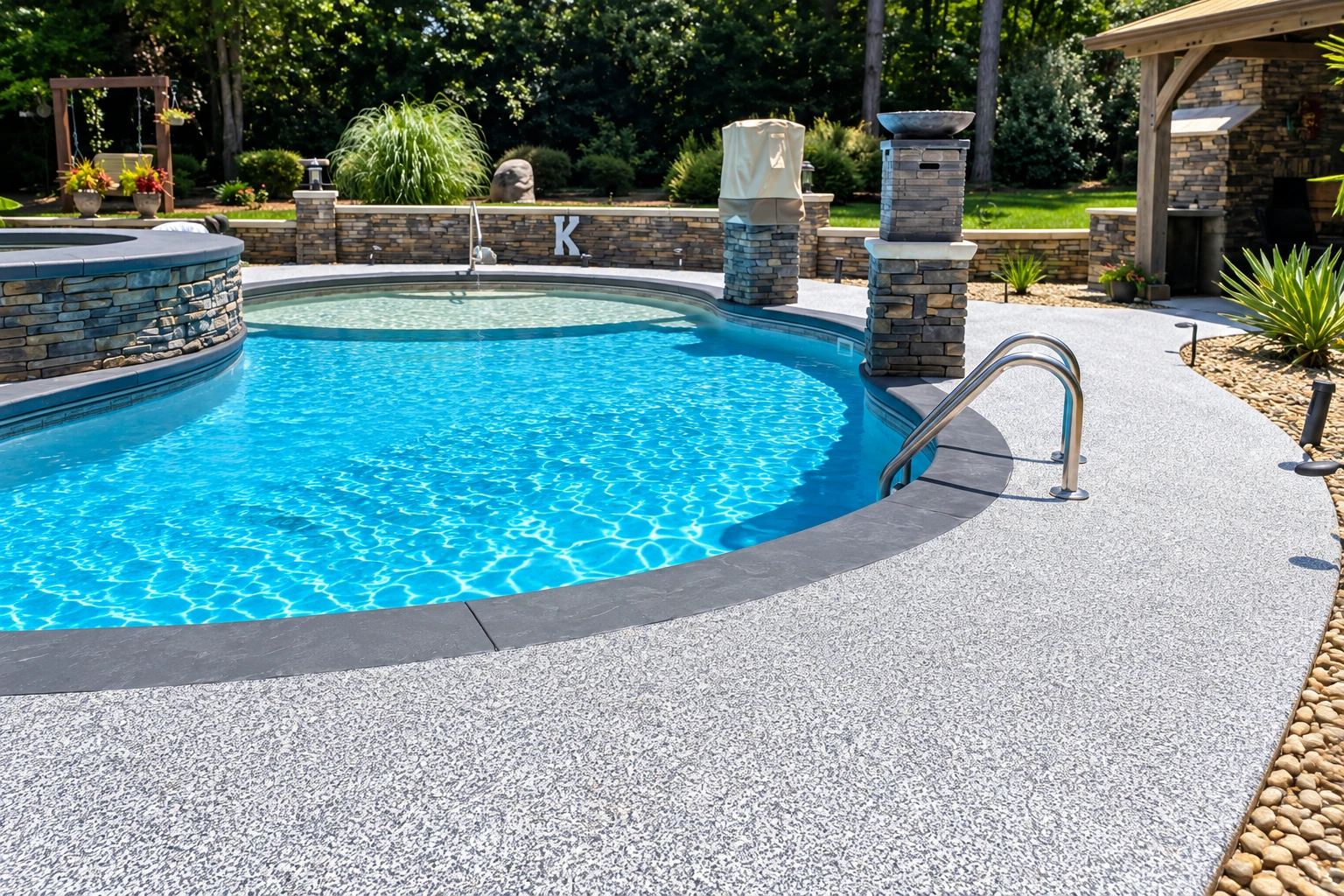
Concrete pool decks in Fayetteville AR - a deck that drains and grips wet feet
Slick spots, standing water or cracks by the pool? We build decks that drain away from the house and give wet feet a good grip.
- Licensed and fully insured.
- Free on-site estimates.
- Expect a reply within 1 business day.
What goes into a concrete pool deck, from drains to the finish?
A concrete pool deck in Fayetteville is the slab you walk on around your pool, sloped so water drains away from the house and finished so wet, bare feet don't slip. It usually goes in with the drains, coping and joints planned around it, and often with steps or a slab for a pool house nearby.
Most pool deck calls I get come from one of two places, a new pool that needs a deck around it or an old deck that's cracked, sunk or holds water. The price mostly comes down to the size and shape of the deck, the finish you pick, how many drains it needs, how much digging and base work the ground calls for and whether you want concrete steps poured with it. The schedule depends on where your pool builder is, whether the city needs a permit and a decent day to pour, and the written estimate I send after coming out gives you your own figure.
How do you know your pool deck needs work?
Puddles that won't drain
If water sits on the deck or runs back toward the house after a swim, the slab was likely poured without enough slope to carry it off. Left alone, that water keeps the surface slick, grows green film and soaks the ground along your foundation.
Slick under wet feet
A deck that feels like a skating rink when it's wet usually has a finish that's worn smooth or was too smooth from the start. That's the one problem here that can hurt somebody before it costs you a dime, so it's worth fixing before swim season.
Cracks or a sunken edge
Cracks running out from the pool, or a section that's dropped below the pool's edge, usually mean the ground underneath has moved. Water gets in through those cracks and washes out more of what's under the slab, so they tend to grow.
Work that often goes with a pool deck
Concrete steps construction
Most decks climb to a back door or drop down a slope, and matching concrete steps keep the footing even from the house to the water.
Slab foundation building
A pool house, cabana or equipment shed beside the pool needs a solid slab underneath, and it's easier to get right while the ground is already open.
How we build a concrete pool deck
A pool deck has to drain, grip wet feet and move apart from the pool, so we work from the pool builder's joint plan and settle the drains, skimmers and coping along the pool's top edge before we form anything. On a new pool, I want to see the fill around the shell packed down first. Then our crew digs out to firm subgrade, the ground the slab sits on, packs the base and sets forms so the deck slopes away from the house and toward any drains without sending dirty water into the pool. We pour in the cooler part of the day so the top doesn't dry out weak and dusty, give it a finish bare feet can grip, cut control joints, grooves that give the slab a planned place to crack, and keep it damp while it cures. If the budget gets tight, I'd rather you go plainer on the finish than skimp on the base, because the base is the part nobody sees on day one and everybody sees once the deck starts sinking.
The deck rarely stops at the pool's edge. If it meets a back door or a slope, we can pour concrete steps in the same job so the rise matches the deck, and if a pool house or cabana is on your list, its slab foundation should be planned with the deck so the heights and the drainage line up.
Deck around a new pool
This suits you if the pool's still going in, because we can work alongside the pool builder and pour once they're done around the shell. It's the best time to get drains, coping and joints planned together instead of worked around later.
Replacing a worn-out deck
If your old deck is cracked, sunk or slick, we tear it out, fix whatever underneath let it fail and pour new. It costs more than patching, but it's usually the only real fix for a deck built on a bad base or with water running the wrong way.
Get a free on-site estimate for your pool deck
We'll reply within one business day to set a time for me to come out and measure, with no obligation. Rather talk? Call (479) 598-4435.
Call (479) 598-4435Why Fayetteville pool owners call AJ Fayetteville Concrete Construction
I measure it and run it
I come out to look at the job myself, and I'm on site running it while our crew handles the prep, forming, pouring and finishing. The person answering your questions at the estimate is the same one standing on the deck on pour day.
Trained on a public works crew
I learned concrete pouring sidewalks and curbs for a city public works crew, and I started this business in 2020. Six years in, we still work the way that crew taught me, ground and drainage first.
Licensed and fully insured, every job
We're licensed and fully insured. On a pool job in Fayetteville that's more than a line on a card, because the city's pool permit needs a contractor's license unless the owner signs an affidavit to do the work on the home they live in.
Permits checked before we schedule
Before we set a date, I check with the building office in whichever city the job's in, Fayetteville or anywhere else around Northwest Arkansas, and if a permit's needed we handle the paperwork and line up the inspections. A big deck in Fayetteville can also call for the city's Green Stormwater Practices worksheet, which applies when a project adds between 1,201 and 10,000 square feet of hard surface.
What matters most on a pool deck is what's under it and around its edges, and I'd rather you ask about that now than find out the hard way. Tell us about your deck and I'll come take a look.
What happens after you call about a pool deck?
Call or send the form
You call (479) 598-4435 or send the form, and we get back to you to set a time for me to come out. If your pool's new, tell us where the pool builder is so we can plan around them.
I walk and measure the deck
I walk the area with you, measure, look at where the water goes and talk through finishes and drains. Then I send a written estimate you can take your time with, and nothing's booked until you say go.
We check permits and prep
Once you say go, I check with the city and line up any inspections, then our crew preps the base and sets the forms. This is the step that decides how the deck holds up, so it doesn't get rushed.
We pour, finish and walk it
We pour, finish and cut the joints, then let it cure before anyone's on it. When it's done, I walk the deck with you so you can see the slope, the joints and the finish for yourself.
Common questions
How much does a concrete pool deck cost in Fayetteville, AR?
Across the US, installing a concrete pool deck usually costs about $10 to $12 per square foot, and that's a general market figure, not our price. Where yours lands depends on the deck you want and the ground it sits on, and the written estimate I send after measuring gives you your own number.
Which pool deck finish is safest for wet, bare feet?
A textured finish with real grip, like a broom finish with fine ridges dragged into the top or exposed aggregate, is usually a safer pick than anything slick. Broom, textured, exposed aggregate, coatings, overlays and decorative finishes all differ in grip and in how hot they get, and very dark finishes can get uncomfortable in full sun. When I'm out, we'll compare the ones you like on grip and heat before we talk looks.
What causes a concrete pool deck to crack?
Most pool deck cracks come from the ground settling underneath or from the deck and the pool shell moving differently with nothing to let them. New pools often leave backfilled dirt around the shell, and if it isn't placed and packed properly, it settles later and cracks the deck. Odd, narrow panels crack easily too, which is why the joints get laid out around curves, drains, corners and the deck's shape, following the pool builder's plan I mentioned above.
How do I take care of a concrete pool deck?
The main job is keeping an eye on the stretchy caulk in the joint between the deck and the pool. One maker's guide says to check that joint every year and repair or replace the caulk when it cracks, pulls away or breaks down, and the same maker says most of these caulks last five to ten years. So plan on resealing it now and then, the way you'd repaint trim.
How long does a new concrete pool deck take to cure before I can use it?
One Michigan trade group's guidance is to cure the slab right after finishing for seven days at around 70°F, with less or more time as conditions require. Curing means keeping the new concrete damp so it hardens slowly and gains strength, and rushing it leaves a weaker surface. I'll tell you when yours is ready based on how the pour and the weather go.
Do I need a permit for a pool deck in Fayetteville?
If the deck goes in with a new pool, it's part of the pool permit, because the city's pool permit checklist has the site plan show the decking, along with distances to property lines, easements and setbacks for anything over 30 inches tall. For a new deck at an existing pool, the city's Development Services office is the place to ask, and that's one of the first calls I make.
Get your pool deck planned right
Call (479) 598-4435 or send the form with your rough deck size, whether the pool is new and the finish you're leaning toward, and I'll show up ready to talk specifics.